The Best Cafe Racer Jackets
A jacket has one job the look can't do — stay on and hold armour in a slide. These all carry the cafe-racer aesthetic and real, CE-tested protection, ranked by how you ride and what you'll spend.

HWK Cafe Racer Leather
A genuine-leather, cafe-cut jacket with removable armour at a fraction of boutique prices. The finish is budget and you should confirm the armour level with the maker, but the leather and the protection are real.
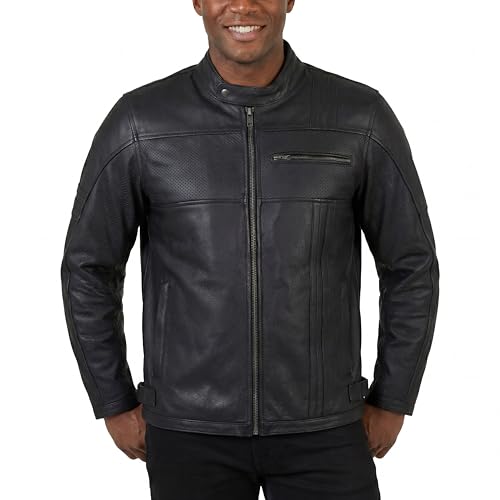
Vance Cafe Racer Leather
A commuter-friendly cafe-racer cut with armour pockets — a practical everyday leather that looks the part without the boutique price.

Waxed Cotton Armoured Jacket
The waxed-cotton aesthetic with armour at an entry price. It is not a Belstaff Trialmaster — buy those direct — but it gets the look for far less.

Milwaukee Leather Racer
A long-running US catalogue brand — racer-style leather with CE armour, sized generously. A safe, mid-tier everyday choice.

Rev'IT! Ignition 4 H2O
Level 2 limb armour where most jackets are Level 1, plus a removable waterproof/thermal liner for year-round use — less boutique-cafe, more do-everything leather jacket.

Highway 21 Winchester
The honest budget pick — real CE Level 1 armour at a fraction of the leather options. Fit and finish are basic and it isn't leather, but it doesn't pretend to protect you when it doesn't.
Leather, waxed cotton or textile?
The shell sets the look and the weather behaviour; the armour sets the protection (more on that below). Three materials fit the cafe world:
- Leather is the archetype — the cafe look descends straight from 1950s–60s British Rocker culture and makers like Lewis Leathers. Cowhide is the durable standard; goatskin is softer and more supple but abrades less per unit of thickness. What matters more than the word "leather" is the grade and thickness: full- or top-grain at roughly 1.0–1.2mm+ is protection-weight, thin "genuine" leather is fashion-weight. Heavy, hot in summer, needs care — but best abrasion resistance for the weight.
- Waxed cotton is the other period-correct material (Belstaff's Trialmaster is the icon). Genuinely water-repellent when waxed, softer heritage look, but lower abrasion resistance than thick leather on its own and it needs periodic re-proofing or it stops shedding water.
- Textile (Cordura/ballistic nylon) strays furthest from the vintage look but is the most versatile: cooler, often with removable liners and pre-formed CE-armour pockets as standard, and usually the cheapest route to genuinely certified protection. A big denier number on the label is not by itself a safety guarantee.
Armour and the CE standard
The armour is the only independently tested part of most jackets, so it's where to focus. EN 1621-1 covers limb (shoulder/elbow) protectors and EN 1621-2 covers back protectors, each rated Level 1 or Level 2 — SATRA summarises Level 1 limb armour at ≤35kN mean transmitted force and Level 2 at ≤20kN (back protectors ≤18kN vs ≤9kN), so Level 2 roughly halves the force reaching you for usually a small price difference. Two traps to know: many jackets ship with a foam placeholder in the back, not a certified protector, so "back protector pocket" is not the same as "back protector included"; and "CE armour included" only certifies the inserts, not the jacket.
For the whole garment there's a separate, stronger standard: EN 17092 (which replaced EN 13595), classifying a finished jacket AAA > AA > A > B > C. AAA is the highest abrasion class with mandatory limb armour; AA and A step down the abrasion requirement; B rates the fabric but requires no armour; C is armour-only with no abrasion rating (a base layer). A jacket rated EN 17092 AA or AAA has had its shell, seams and armour tested together — a much stronger claim than "CE Level 2 armour" fitted to an untested shell.
Fit for riding
A riding jacket is cut tighter than a fashion jacket on purpose: the armour only protects if it stays over the joint on impact, and a baggy "vintage fit" lets the pads slide off the elbow. Look for pre-curved sleeves shaped for the arms-forward posture, and check sleeve length with your arms extended as if reaching the bars — the cuffs should still cover your wrists there, not just when you stand. On a cafe racer's forward lean, enough length through the back to stay covered when you bend forward matters too.
Cafe racer jackets — FAQ
Is a leather jacket necessary for a cafe racer?
Not for the bike, but it is the historically and visually "correct" choice — the cafe-racer look descends directly from 1950s–60s British Rocker culture, where heavy leather jackets (popularised by makers like Lewis Leathers) were the uniform. Waxed cotton is the other period-authentic option, and modern textile jackets are functionally sound but stray furthest from the classic silhouette.
What CE armour level do I need — Level 1 or Level 2?
Level 2 transmits roughly half the force of Level 1 to your body. SATRA summarises EN 1621-1 limb armour as ≤35kN mean transmitted force at Level 1 versus ≤20kN at Level 2, and EN 1621-2 back protectors at ≤18kN versus ≤9kN — so for a usually small price difference, Level 2 is a meaningful upgrade, and many reviewers default to Level 2 for the back given how serious spinal injuries are.
Waxed cotton or leather for a cafe racer?
Both are period-correct. Thick full-grain leather gives the best abrasion resistance and the classic silhouette; waxed cotton gives better everyday weather resistance and a softer heritage look but has lower abrasion resistance on its own and needs periodic re-waxing to stay water-repellent. Neither is "wrong" — it is a look-and-weather trade-off, with leather ahead on pure slide protection.
Do cafe racer jackets come with a back protector?
Often not a real one. Many jackets ship with only a foam placeholder in the back pocket rather than certified EN 1621-2 armour, and expect you to buy and fit a Level 1 or Level 2 back protector separately. Read the listing carefully: "back protector included" (certified) is very different from "back protector pocket" (empty).
How should a riding jacket fit?
Snugger than a fashion jacket, so the armour stays over the joint in a crash instead of sliding off. Look for pre-curved sleeves and check the sleeve length with your arms extended forward as if gripping the bars — the cuffs should still cover your wrists in that position, not just when you stand upright. A jacket that fits standing but rides up reaching for the bars is a fit failure specific to riding gear.
Can I use a fashion leather jacket for riding?
Not safely as primary gear. Fashion jackets are cut loosely so any armour shifts out of place, often use thin "genuine" or split leather rather than thick full-grain hide, and usually carry no CE rating of any kind — meaning no verified abrasion or impact protection in a slide. The look is the same; the protection is not.
Links go to Amazon (affiliate-tagged). Prices shown as tiers, not scraped figures — confirm current pricing and exact CE spec on the maker's page before buying.